Showing posts with label nightmare before christmas. Show all posts
Showing posts with label nightmare before christmas. Show all posts
Saturday, March 15, 2014
VIDEO: Tim Burton Receives BAF Award
Check out this recently uploaded video of Tim Burton receiving the 2013 BAF award from the Bradford Animation Festival.

Wednesday, February 12, 2014
Burton & "The Kids from CalArts" in Vanity Fair

Photograph by Annie Leibovitz. From left: Steve Hillenburg, Tim Burton, Brad Bird, Mark Andrews (in ape suit), Jerry Rees, Chris Buck (with Viking helmet), John Musker, Genndy Tartakovsky, Leslie Gorin, Mike Giaimo, Brenda Chapman, Glen Keane, Kirk Wise (in beige sweater), Andrew Stanton, Pete Docter (with Lei), Rob Minkoff, Rich Moore, John Lasseter, and Henry Selick, in the famed CalArts classroom A113.
Sunday, January 12, 2014
New eBook: "The Animated Films of Tim Burton"

A new eBook has been published, Direct Conversations: The Animated Films of Tim Burton. Written by Tim Lammers, the 48-page book comes with a foreword by Tim Burton.
Description: Throughout his career, movie journalist Tim Lammers has talked with director Tim Burton and the key players who helped bring the stop-motion films The Nightmare Before Christmas, Corpse Bride, and Frankenweenie to life.
Now for the first time, Lammers has assembled the stories from Burton and his band of creatives all in one place. In Direct Conversations: The Animated Films of Tim Burton, you will not only hear from Burton, but Danny Elfman, Chris Sarandon, Allison Abbate, Martin Landau, Elijah Wood, Atticus Shaffer, Helena Bonham Carter, Alan Rickman, the late Ray Harryhausen, and more. The release of Direct Conversations: The Animated Films of Tim Burton comes as the 1993 classic The Nightmare Before Christmas celebrates its 20th anniversary.
Direct Conversations: The Animated Films of Tim Burton examines such films as The Nightmare Before Christmas, Corpse Bride, 9, and Frankenweenie. Physical copies are unavailable, but you can purchase the eBook for $4.99 USD.
Sunday, October 27, 2013
Video: Tim Burton on "Nightmare" 20th Anniversary
Check out this spooktacular new video from Tim Burton on the 20th anniversary of The Nightmare Before Christmas, just in time for Halloween!:
Starring Tim Burton, Aiko Horiuchi (The Grudge) and Glen Mexted (Camden Claus/Captain Rubberpants). Music by Danny Elfman. Directed by Derek Frey.
Starring Tim Burton, Aiko Horiuchi (The Grudge) and Glen Mexted (Camden Claus/Captain Rubberpants). Music by Danny Elfman. Directed by Derek Frey.
Thursday, September 26, 2013
"Nightmare" Opens Bradford Animation Festival

In recognition of the cult classic's 20th anniversary, this year's edition of the Bradford Animation Festival in the UK will open with a special presentation of Tim Burton's The Nightmare Before Christmas.
Bradford Animation Festival runs from November 12-16 at the National Media Museum and the University of Bradford. For tickets or more information ring 0844 856 3797 or visit baf.org.uk.
Elfman/Burton Concert in L.A. Adds Third Performance

Good news for those of you in Los Angeles! The L.A. Times reports that, due to extremely popular demand, there will be not one, not two, but three performances of the concert celebrating over a quarter-century of music by Danny Elfman from the films of Tim Burton. Mr. Elfman himself will be present to perform songs from The Nightmare Before Christmas live at the Nokia Theater. Listed below are the performances, with links to purchase tickets in bold:
Tuesday, October 29th, 8:15 PM
Wednesday, October 30th, 8:30 PM
Thursday, October 31st, 8:15 PM
Monday, September 09, 2013
Elfman/Burton Concert Coming to L.A.

From the original article by the Los Angeles Times:
It's been one of the most fruitful composer-director collaborations in modern Hollywood.
Danny Elfman has scored 15 movies by Tim Burton, starting with "Pee-Wee's Big Adventure" in 1985 and leading up to last year's "Dark Shadows" and "Frankenweenie." For the first time in the U.S., Elfman is to present his scores for Burton's films in an orchestral concert performance, scheduled appropriately enough for Halloween night at the Nokia Theatre in downtown Los Angeles.
"Danny Elfman's Music from the Films of Tim Burton" will feature conductor John Mauceri leading the 87-piece Hollywood Symphony Orchestra and the 45-member Page L.A. Choir. Elfman himself will appear at the concert to perform songs from "The Nightmare Before Christmas."
The concert will debut Oct. 7 at London's Royal Albert Hall with the BBC Concert Orchestra, part of a British tour, prior to coming to L.A.
Organizers said the concert will feature music from all 15 of Elfman's collaborations with Burton. (The only Burton movies that the composer didn't work on were "Ed Wood" and "Sweeney Todd.") The concert will also include film clips from Burton's movies and some of his art work.
A U.S. tour of the concert is in the works, but no dates or cities have been announced yet.
Elfman was the composer for the Cirque du Soleil show "Iris," which closed at the Dolby Theatre in Hollywood in January. He was part of the influential rock group Oingo Boingo, which held a farewell concert in 1995 at the Universal Amphitheatre.
The composer previously worked with Mauceri on "Serenada Schizophrana," a 2004 classical piece that was recorded and released two years later. They also collaborated on "The Overeager Overture," which was performed at the Hollywood Bowl in 2006.
Mauceri was the music director of the Hollywood Bowl Orchestra for 15 years beginning with its inception in 1991.
"Danny Elfman's Music from the Films of Tim Burton" is scheduled for 8:15 p.m. on Oct. 31 at the Nokia Theatre at L.A. Live. Tickets go on sale Sept. 13 at 10 a.m. through AXS.com, and by phone at (888) 929-7849.
PHOTO: Danny Elfman in Los Angeles in 2011. (Mel Melcon / Los Angeles Times)
Thursday, February 14, 2013
Danny Elfman/Tim Burton Concert at Royal Albert Hall

Tickets are now on sale for "Danny Elfman's Music from the Films of Tim Burton," a concert that will take place at the Royal Albert Hall in London on Monday, 7th of October, 2013, and will feature Danny Elfman in person!
Read the official press release below:
On Monday 7 October 2013, the Royal Albert Hall will be hosting an exclusive World Premiere of Danny Elfman’s Music from the Films of Tim Burton, celebrating the extraordinary collaboration between the acclaimed composer and visionary filmmaker.
The concert will see Danny Elfman‘s famous Tim Burton film scores brought to life on stage by the BBC Concert Orchestra conducted by John Mauceri, whilst visuals from Burton’s original production artwork, sketches and drawings are displayed on the big screen. There will also be an exclusive special guest performance by four-time Oscar-nominated Danny Elfman himself, making his first public singing performance in 18 years.
With a range of films from a fascinating back-catalogue of classics including Beetlejuice, Batman, Edward Scissorhands, The Nightmare Before Christmas, and Alice in Wonderland, this concert will explore the collaborative relationship between music and storytelling and the process and importance that this has in filmmaking.
Quotes:
“I’ve always heard Danny’s scores performed live during our recording sessions for the films we’ve collaborated on… for others to finally be able to hear his music live, at such a historic venue as the Royal Albert Hall, is really something special.”
-Tim Burton
“I really look forward to revisiting this body of work which has been such a huge part of my life and bringing it to the concert stage. And the idea of performing some of Jack Skellington’s songs from The Nightmare Before Christmas live for the very first time is immensely exciting.”
-Danny Elfman
Tickets:
Tickets for Danny Elfman’s Music from the Films of Tim Burton go on sale at 9am on Thursday 14 February and start at £20 (booking fees may apply).
Buy online at www.royalalberthall.com or phone the Box Office on 020 7589 8212
Monday, January 28, 2013
Interview: Burton on Oscars, "Frankenweenie," Critics

Vulture spoke with Tim Burton to learn about Frankenweenie and its chances at winning an Oscar this year, his balance between films that are critical successes and box office hits, his broken arm, and more:
Do all the nominations and awards help make up for the film's less-than-blockbuster box -office performance?
It's really nice, especially for a film like that. Everybody works really hard for something like this, especially the people who work in a dark room for a couple of years. The thing about stop-motion is that it's such a slow, painful process — one frame at a time. The positive side is that it helps keep the medium alive. It's not high on to-do lists for studio execs to make stop-motion, let alone black-and-white stop-motion. There's still a bit of a stigma, so any sort of positive response is meaningful.
You would think after The Artist there would be less opposition to black-and-white — especially when it comes to films about Hollywood. Argo also got a lot of awards love partly because it's about Hollywood helping to save the world. And Frankenweenie celebrates classic horror films. Hollywood loves nothing more than celebrating itself.
That's true, now that you mention that. Even last year, films like Hugo did that. But I never really thought of that. It's certainly not my perception of the world. For me, it's just what inspires me, and those monster movies stay with you on some kind of level. Those early things are still inside of me. It was just fun to play around with words and themes and memories, because you don't get to do that on every project.
Loved the shout-out to Mary Shelley with the turtle's name, by the way.
[Chuckles.] My son's turtle was named Shelley. When you have a pet as a child, that's the first pure relationship you have. It's unconditional love. And it's your first experience with death as well, so it was an easy emotional connection to make to Frankenstein and monster movies. Those first relationships are very important. And to me, the Frankenstein story is about creating things, not the business of creating things.
But you still want it to be successful.
No one wants to feel like they weren't, unless they're doing some kind of weird art-house thing: "I hope nobody sees this film! And if they see the film, I'm selling out!" You hope for success, but it's a strange phenomenon. You have a movie that gets shitty, crappy, horrible reviews but makes a lot of money; you have a movie that gets good, decent reviews, but then no one goes to see it. I've been lucky, even if a film didn't do that well [at the box office], I end up meeting people who connected with it, and that evens the score.
How do you feel about the critics who say you should stop using Johnny Depp so much?
I'm in a no-win situation. Some say I use him too often, and then others say, "How come he's not in this one?" Whatever. I'm strangely used to that from the beginning.
I don't decide to make a film because of the actors first, even though there are a lot of people I love. I don't think I've ever gone, "Oh, I want to work with that person," and then specifically found a part with that person just to work with them. For Frankenweenie, I hadn't worked with Winona Ryder, Catherine O'Hara, Martin Short, or Martin Landau in a long time, so that was great. But the project drew me to them because they're all so talented.
With Catherine, not since Beetlejuice. People want a sequel for that one.
Those were fun characters, but I'd have to see what the script was like and if it was worth doing — I can't just make it because it's one of the worst ten movies of the year! The first two films I did, Pee-wee's Big Adventure and Beetlejuice, made the ten-worst-movies-of-the-year lists. Then, years later, people said they were my best movies. What? So if those were my best, I'm in real trouble. [Laughs.] The point is, even if I wanted to analyze it, I'm not going to make everyone happy. It's easier when you're starting out and people don't really know what you are. But then you become a thing, and that's not really what you want. I never really targeted my films for kids. It's just what I like to make. But then people were saying The Nightmare Before Christmas was too scary for kids — too much singing, too scary. And then the kids loved it. So I've had conflicting information from the beginning.
How is The Nightmare Before Christmas too scary? It's no scarier than any fairy tale ...
Exactly. When you were a child, did you ever see Disney movies? There's some scary stuff in there. That's what made Disney movies to a large degree, but as people get older, they kind of forget that. There's a new generation looking at fairy tales now, and that's what monster movies were for me. I've always been interested in those kinds of stories, the ones that have been around for ages. When I go back and reread "Red Riding Hood," it's so bizarre, so weird, so fascinating, and we forget how strange they were, even if they've stayed in our consciousness for ages. Fairy tales are amazing, intense, psychological horror stories. But if you ask most adults, they immediately think it's all princesses and happy endings, and it's so not. Obviously.
Are you still thinking about doing Pinocchio next?
It's really hard to think about doing anything when I've got a throbbing pain in my shoulder! The painkillers are not that good here. The doctors are like, "Take two aspirin."
You're in London. Codeine is over-the-counter there!
Yeah, but it's a pretty weak form of codeine, probably. But you're right. I should do that. [Laughs.] I'm hoping the pain subsides soon, but it's like when you have a toothache, and it's hard to think, hard to do things, hard to focus on what's going on when it's throbbing away.
Once the pain subsides, then you can consider Pinocchio, or perhaps a Walt Disney biopic starring Ryan Gosling. Have you seen that poster?
The story at Cal Arts was that Walt was cryogenically frozen and somewhere in the basement. We used to spend Friday nights looking for him. So that's the story. Listen, I'm open to ideas at the moment!
Tuesday, October 30, 2012

Saturday, September 29, 2012
Elfman on "Frankenweenie" Soundtrack

The original soundtrack for the film, Frankenweenie, composed by Danny Elfman (his 15th collaboration with Tim Burton) is now available.
"It's something that takes me back to The Nightmare Before Christmas, which also had a very simple story," said Elfman to the Sacramento Bee. "It's very pure Tim and very uniquely Tim in that regard—the look and the feel of it and it's great to be able to frolic in that realm."
"Frankenweenie is very sweet but then there's this monster movie side of it that I really got to tap into my own roots as a life-long fan of that genre," said Elfman.
"There's a theme for Victor and his relationship with his dog and then there's actually a theme for Sparky himself," Elfman described. "Sparky's theme is more playful, as dogs are. Victor's theme is a little sadder because it's more about how much he loves and misses Sparky. It is ultimately a story about a boy and his dog and there's almost nothing purer than that."
You can order the soundtrack at Amazon.com.

The album "Frankenweenie Unleashed!," which features 16 songs inspired by the film, is also now available.
Saturday, September 22, 2012
Tim Burton: At Home in His Own Head
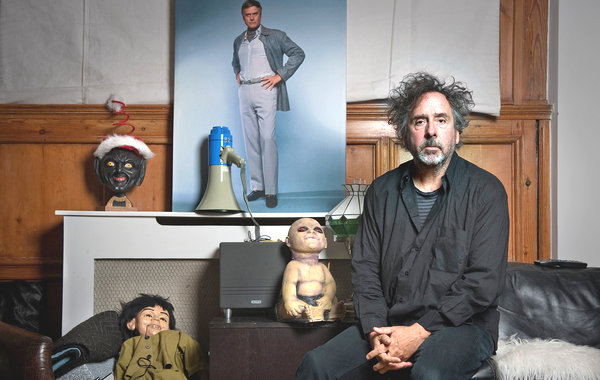
The New York Times published a thorough article about and interview with filmmaker Tim Burton. Here it is in its entirety:
September 19, 2012
Tim Burton, at Home in His Own Head
By DAVE ITZKOFF
LONDON
IT would be a tremendous disappointment if Tim Burton’s inner sanctum turned out to be a sterile environment, barren except for a telephone on its cold white floor; or a cubicle with a “World’s Greatest Dad” coffee mug. Instead, the workplace of the filmmaker behind invitingly grim delights like “Beetlejuice” and “Edward Scissorhands” is a definitive Burtonesque experience: on a hill here in north London, behind a brick wall and a mournful tree, in a Victorian residence that once belonged to the children’s book illustrator Arthur Rackham, it lies at the top of a winding staircase guarded by the imposing portraits of Boris Karloff and Christopher Lee. Its décor is best characterized as Modern Nonconformist (unless Ultraman toys and models of skeletal warriors are your thing), and when the master of the house greets you, his drinking glass will bear a poster image for “The Curse of Frankenstein.”
That the word Burtonesque has become part of the cultural lexicon hints at the surprising influence Mr. Burton, 54, has accumulated in a directorial career that spans 16 features and nearly 30 years. Across films as disparate as “Ed Wood,” “Alice in Wonderland” and “Big Fish” — released to varying critical and commercial receptions — he has developed a singular if not easily pinned-down sensibility. His style is strongly visual, darkly comic and morbidly fixated, but it is rooted just as much in his affection for monsters and misfits (which in his movies often turn out to be the same thing). He all but invented the vocabulary of the modern superhero movie (with “Batman"), brought new vitality to stop-motion animation (with “Corpse Bride,” directed with Mike Johnson, and “The Nightmare Before Christmas,” which Mr. Burton produced) and has come to be associated, for better or worse, with anything that is ghoulish or ghastly without being inaccessible. He may be the most widely embraced loner in contemporary cinema.
His success has also transported him from sleepy, suburban Southern California, where he grew up and graduated from the California Institute of the Arts, to London, where he lives with his partner, the actress Helena Bonham Carter, and their two young children, and where he has come to embrace the sensation of being perpetually out of place.
“I just feel like a foreigner,” Mr. Burton said in his cheerful, elliptical manner. “Feeling that weird foreign quality just makes you feel more, strangely, at home.”
On a recent morning Mr. Burton, dressed entirely in black, was talking about his new animated feature, “Frankenweenie,” which will be released by Walt Disney on Oct. 5., and which tells the charming story of a young boy (named Victor Frankenstein) who reanimates the corpse of his dead pet dog.
Like its director “Frankenweenie” is simultaneously modern and retrograde: the film, which is being released in 3-D black-and-white, is adapted from a live-action short that Mr. Burton made for Disney in 1984, when he was a struggling animator. That project did not get the wide release Mr. Burton hoped for, but it paved the way for him to direct his first feature, “Pee-wee’s Big Adventure,” the following year.
As he spoke (and occasionally shaped his feral, curly hair into something resembling satyr horns), Mr. Burton was in a nostalgic mood but also a defiant one. That may have been the result of the tepid reception that greeted “Dark Shadows,” his big-budget remake of the TV soap opera (which Mr. Burton said did not disappoint him), or a reluctance to analyze trends in his career. Whether he was talking about his upbringing in Burbank, his earliest frustration at Disney or the unexpected honor of a career retrospective presented at the Museum of Modern Art and other institutions, Mr. Burton still casts himself as an outsider.
“Wanting people to like you is nice, but I’m confident that there’s always going to be lots that don’t,” Mr. Burton said with gallows humor and genuine pride. “I’ll always be able to hang on to that.” These are excerpts from this conversation.
Q. Not only does “Frankenweenie” hark back to the start of your career, it seems to refer to many of the features you’ve made since the original short. Is that by design?
A. If I really thought about it, that’s something I would probably not do. [Laughs.] I don’t consciously make those points of: I did this, I’m going to put that in there as a reference to myself. Things that I grew up with stay with me. You start a certain way, and then you spend your whole life trying to find a certain simplicity that you had. It’s less about staying in childhood than keeping a certain spirit of seeing things in a different way.
Q. How much of your childhood are we seeing in Victor’s isolation?
A. I felt like an outcast. At the same time I felt quite normal. I think a lot of kids feel alone and slightly isolated and in their own world. I don’t believe the feelings I had were unique. You can sit in a classroom and feel like no one understands you, and you’re Vincent Price in “House of Usher.” I would imagine, if you talk to every single kid, most of them probably felt similarly. But I felt very tortured as a teenager. That’s where “Edward Scissorhands” came from. I was probably clinically depressed and didn’t know it.
Q. Were you encouraged to try sports?
A. My dad was a professional baseball player. He got injured early in his career, so he didn’t fulfill that dream of his. He ended up working for the sports department of the city of Burbank. I did some sports. It was a bit frustrating. I wasn’t the greatest sports person.
Q. That can be deeply disheartening at that age, to learn that you’re bad at something.
A. It’s the same with drawing. If you look at children’s drawings, they’re all great. And then at a certain point, even when they’re about 7 or 8 or 9, they go, “Oh, I can’t draw.” Well, yes, you can. I went through that same thing, even when I started to go to CalArts, and a couple of teachers said: “Don’t worry about it. If you like to draw, just draw.” And that just liberated me. My mother wasn’t an artist, but she made these weird owls out of pine cones, or cat needlepoint things. There’s an outlet for everyone, you know?
Q. Were horror films and B movies easily accessible when you were growing up?
A. They’d show monster movies on regular TV then, which they wouldn’t show now. Some of them were pretty hard core, like “The Brain That Wouldn’t Die,” or something where a guy gets his arm ripped off and is bleeding down the wall. My parents were a bit freaked out. [Laughs.] But better that I’m watching TV than them having to watch me or deal with me.
Q. There are emotions and experiences in “Frankenweenie” that audiences don’t often associate with Disney features.
A. People get worried and they go, “Oh my God, the dog gets hit by a car.” It’s funny how people are afraid of their emotions. I remember the original short was supposed to go out with “Pinocchio,” and they got all freaked out about it, like kids would be running, screaming, from the theater.
Q. Do you find poetic justice in the fact that, after all that, Disney is the studio that’s releasing “Frankenweenie"?
A. I feel like I’ve been through a revolving door over the years, and from my first time there as an animator to “Frankenweenie” to “Nightmare” and “Ed Wood,” it’s always been the same reaction: “Come back,” and then “Hmmm, I don’t know.” After I stopped working on “The Fox and the Hound” and trying to be a Disney animator — which was useless — they gave me the opportunity, for a year or two, to draw whatever I wanted. I felt quite grateful for it. At the same time I felt like Rapunzel, a princess trapped in a tower. I had everything I needed except the light of day. I felt they didn’t really want me, and luckily Warner Brothers and Paul Reubens and the producers of “Pee-wee” saw the movie and gave me a chance.
Q. If “Pee-wee’s Big Adventure” and “Beetlejuice” hadn’t been hits, would that have been the end of your filmmaking career?
A. I always felt bad for people whose first movie is a gigantic hit. [Laughs.] They were movies that were under the radar in a certain way. They’re both low-budget in terms of studio movies. Both were moderate hits, and were on some of the “10 worst movies of the year” lists. I learned quite early on: don’t get too excited, don’t get too complacent, don’t get too egotistical.
Q. When you see, 23 years after “Batman,” the extent to which superhero movies have become the backbone of Hollywood, do you feel a sense of pride or ownership?
A. No, not ownership. At the time it felt like the first attempt at a darker version of a comic book. Now it looks like a lighthearted romp. If I recall correctly, it wasn’t the greatest-received critical movie. So I do feel strange for getting such a bad rap on some level, and nobody mentions, oh, maybe it helped start something.
Q. When you worked with Johnny Depp for the first time, on “Edward Scissorhands,” what was it that connected you to him?
A. Here was a guy who was perceived as this thing — this Tiger Beat teen idol. But just meeting him, I could tell, without knowing the guy, he wasn’t that as a person. Very simply, he fit the profile of the character. We were in Florida in 90-degree heat, and he couldn’t use his hands, and he was wearing a leather outfit and covered head to toe with makeup. I was impressed by his strength and stamina. I remember Jack Nicholson showed me this book about mask acting and how it unleashes something else in a person. I’ve always been impressed by anybody that was willing to do that. Because a lot of actors don’t want to cover [theatrical voice] “the instrument.”
Q. Has your relationship with Johnny changed as your careers have evolved?
A. There’s always been a shorthand. He’s always been able to decipher my ramblings. To me he’s more like a Boris Karloff-type actor, a character actor, than a leading man. The only thing that changes — and this is something I try not to pay any attention to — is how the outside world perceives it. [Snidely] “Oh, you’re working with Johnny again?” “Oh, how come you’re not working with him this time?” You can’t win. I give up.
Q. You don’t have a formal repertory company, but there seem to be certain actors you come back to.
A. [Sighs.] I don’t want to respond to criticism I hear. People that go, “Oh, he’s using her again,” or “He’s using him again.” I’ve enjoyed pretty much everybody I’ve worked with. But it’s good to mix it up. If somebody’s right for the part — I’ve worked with them? Fine. Haven’t? Fine.
Q. Having a life with Helena Bonham Carter, do you have to be more careful about how you use her in your films?
A. The great thing about her is that, long before I met her, she had a full career. She’s also willing to do things that aren’t necessarily glamorous or attractive [Laughs], and I admire her for that. We’ve learned how to leave things at home, make it more of a sanctuary. But I probably take a slight, extra moment to think about it. On “Sweeney Todd” it was quite rough. Nobody was a singer, so I looked at lots of people. Everybody had to audition for it; she did as well. That one was a struggle, because I felt like, jeez, there’s a lot of great singers, and it’s going to look like I gave this one to my girlfriend. She really went through an extra process.
Q. In your last couple of movies you’ve burned her to a crisp, you’ve dumped her at the bottom of the ocean ——
A. I know. But she’s getting it on other movies. She’s being burned up alive a lot lately, or she’s getting set on fire quite a lot. Again, I’ve set another trend.
Q. Your “Planet of the Apes” remake introduced you to Helena, but was it otherwise a professional low for you?
A. Yeah. I’ve tried to learn my lesson. It usually happens on bigger-budget movies. You go into it, and there’s something about it I like, the studio wants to do it. But the budget’s not set and the script’s not set. So you’ve got this moving train. You’re working on it, and you’re cutting this because the budget’s too big, and you feel like an accountant. It’s certainly perceived as one of my least successful films. But at the same time I met with and worked with a lot of people that I loved.
Q. Will you ever explain its ending?
A. I had it all worked out. But it’s my own private thing. Someday we’ll go take some LSD and we’ll talk about it.
Q. Your recent films, like “Sweeney Todd,” “Alice in Wonderland” and “Charlie and the Chocolate Factory,"have all in some way been based on existing properties.
A. I’ve heard that, but a lot of things are, in a way. Even “Alice,” there’s a book, there’s lots of different versions. But there was no movie I would look to and go, “Ooh, we’re going to have to top that ‘Alice.’ “
Q. Is it harder to put your personal stamp on something you didn’t create from the ground up?
A. For me, no. It may be perceived that way, but I have to personalize everything, whether or not it comes from me. If I were to cherry-pick things, even “Ed Wood” was based on a book, it’s based on a person. “Sweeney Todd” is one of my more personal movies, because the Sweeney Todd character is a character I completely related to. Even in “Planet of the Apes” there are things I have to relate to, otherwise I just can’t do it. “Frankenweenie” is a bit more pure that way. But you could argue it’s based on a short which is based on lots of other movies.
Q. Is it a danger when you have a style that’s so distinctive it becomes boilerplate and imitated?
A. It does bother me a bit. People thought I made “Coraline.” Henry [Selick, who directed “Coraline” and “The Nightmare Before Christmas"] is a great filmmaker, but when they say something, they should have to say the person’s name. “From the producer of " — well, there’s eight producers. It’s slightly misleading. Not slightly, it’s very misleading, and that’s not fair to the consumer. Have the courage to go out under your own name. But I don’t have any control over that, and it’s not going to make me change. I can’t change my personality. Sometimes I wish I could, but I can’t.
Q. Do you think that overfamiliarity might have been a problem with “Dark Shadows,” that people saw it was you, and Johnny, and monsters, and they thought, “I’ve seen this before"?
A. Even the fact that it was deemed a failure — financially, it wasn’t really. It may not have set the world on fire, but it made its money back plus some, so I can tick that off as not being a total disaster. There’s some people that I talk to that liked it. “Alice” got critically panned. It made over a billion, I guess, whatever. “Ed Wood” got a lot of critical acclaim, it was a complete bomb. It all has a weird way of balancing itself out.
Q. When you’ve had your own retrospective at the Museum of Modern Art, do you feel bulletproof after that?
A. That was surreal. A lot of people thought I manufactured that, which I didn’t. They came to me and I was actually quite freaked out about it. To me, it was all private. It was never meant as, like, great art. It’s like hanging your laundry on the wall. “Oh, look, there’s his dirty socks and underwear.” But with the curators I felt I was in good hands, and they were just presenting it like, this is his process, this is what he does.
Q. Did it come with unforeseen pitfalls?
A. It followed suit with the movies. It got dismissed as “It’s not art.” Which I agree with.
Q. Are there other, more traditional forms of recognition you’d still like to earn?
A. Like public office?
Q. Like an Academy Award?
A. I grew up on movies like “Dr. Phibes,” that were not Academy Award-contending movies. [Laughs.] It’s not something that I’ve got to win. It’s like getting into film — I didn’t say early on, “I’m going to become a filmmaker,” “I’m going to show my work at MoMA.” When you start to think those things, you’re in trouble. Surprises are good. They become rarer and rarer as you go on. But anything like that is special. I’m not Woody Allen yet.
Q. This may seem strange to ask someone with many years of work still ahead, but what would you want your legacy to be?
A. What do I want on my gravestone?
Q. It sounds like something you’ve thought about.
A. I do. I think it’s wise to plan ahead. Start early — plan your funeral now. It’s not a morbid thought. If you want something to happen in a certain way, especially the last thing, you might as well.
The thing that I care about most — that you did something that really had an impact on them. People come up on the street, and they have a “Nightmare” tattoo, or little girls saying they love “Sweeney Todd,” and you’re like, “How were you able to see it?” Or you see people, especially around Halloween, dressed up in costume, as Corpse Bride or the Mad Hatter or Sally. It’s not critics, it’s not box office. Things that you know are connecting with real people.
Q. Is there something unrepentantly crowd-pleasing that you’ll admit to enjoying?
A. I’m always bad at this. Name something.
Q. Well, now that “Downton Abbey” is back on in Britain, will you watch it?
A. No. Helena, that’s more her kind of thing. That one I don’t quite get. To me that’s like getting a morphine injection on a Sunday night. And that can have its positives. But not my cup of tea. There’s shows like “MasterChef,” which I cry at. I don’t know why. I find it quite emotional when they cook something, and it doesn’t work out. Movies, I can’t quite think of, but especially if I’m on an airplane — I don’t know why, maybe because you constantly think you’re going to die — I find every movie, I cry if I watch it on a plane.
Q. I had that reaction to “Love Actually.”
A. [Draws a breath.] Ooh, no, no. I saw that with Helena, and I’ll never forget the ad campaign on that one. It was like, “If you don’t love this movie, there’s something wrong with you.” And we saw it, and we got into a fight and argued all the way home. It was the same with “Mamma Mia!” For a feel-good movie, I’ve never been so depressed.
Q. Your kids are old enough to see movies. Do you try to influence their tastes?
A. I don’t overly push it. I was quite proud when my daughter’s favorite movie was “War of the Gargantuas.” But now that she’s older, she’s gone off from that a bit. I don’t push my things on them. If they’re into it, they’re into it. They’ll find it, or not. You’ve got to let them find their way.
Friday, July 13, 2012
Video: "Frankenweenie" Comic-Con Press Conference
Here's a video of the Frankenweenie press conference that took place yesterday at San Diego's Comic-Con 2012. Director Tim Burton, actor Atticus Shaffer (voice of "Edgar"), and producers Allison Abbate and Don Hahn were on the panel, discussing dogs, monsters, family, animation, and much more.
Friday, June 15, 2012
Burton on Making "Frankenweenie" Work

IGN visited Tim Burton for a tour of the making of his stop-motion animated film, Frankenweenie, which some are describing as not only Burton's "dream project," but one of the most personal feature films he's made.
“There’s a kind of House of Frankenstein feel to it,” explains Burton, referring to the 1944 classic film that brought Universal’s horror movie franchises – Dracula, Frankenstein and the Wolfman – together on the screen. “It’s a way for me to go back to what the original concept of the drawings was; stuff and characters I’d been thinking about over the years, without any real framework. So when we decided to do it with [screenwriter] John August, and focused on it with some other monsters, it sort of took on that tone a little bit. But still keeping the essence of what the original was.”
There will be plenty of monsters in the film, but producer Allison Abbate clarified that the real villains of the film will not necessarily be the most grotesque or strange looking. "It’s the people who are the freakish monsters in the story,” says Abbate. “It’s normal school politics on a heightened level,“ Burton elaborates. “It's like that kid you always thought was weird at school, but here he also looks more like Boris Karloff or Peter Lorre. They’re basically all horrible people…”

Burton enthusiastically weaves in and out of his studio like it's his own laboratory. “It’s always quite surreal to see people working on them,” he marvels, “five people on this one house, it’s incredible.”
Some of the sets are even based on Burton's own childhood experiences. “This is the school I went to,” Burton winces, as we tour the local high school, its science lab replete with details like chemistry sets and Bunsen burners. “I can’t stay in this room, it brings back horrible memories!” He squints again at the building’s clean, oppressive outline and regimented rows of desks. “Jeez… is the school [designed by] Leni Riefenstahl?”
Burton has had the unique opportunity to make this film in black and white. Since all of the sets, puppets, and props exist in the real world, everything had to be handmade and shot in reality, with real-world physics to consider. In a sense, it's almost like making a live-action film in slow-motion, rather than a traditional or computer animated movie. “The great thing about this is we light it like it’s a real movie,” Burton enthuses. “Even frame by frame it helps the acting. You kinda feel like a giant on a live-action set, but with that classic black and white richness and depth of field.”
In addition to being in black and white, the film will also be presented in 3D. However, it will not be shot in stereoscopic 3D. But Burton has had experience with such a post-production conversion process on The Nightmare Before Christmas, and feels that it can work. “Knowing you’re going to do it and having the time to do makes sure it’s not a crappy conversion. We took time with Nightmare.”
“People want this ‘revolt against 3D,’” he says impatiently. “I don’t adopt that like it’s one way or the other. It should be a choice. To me, more choice is better than no choice. I’ve seen good 3D and bad 3D movies. I would understand people seeing a crappy 3D movie and feeling ripped off.”
Sunday, May 13, 2012
Production Designer Rick Heinrichs on "Frankenweenie"

Collider recently caught up with Rick Heinrichs, production designer on Frankenweenie. The production designer has worked with Burton on numerous films in different capacities: Edward Scissorhands, Batman Returns, The Nightmare Before Christmas, Sleepy Hollow, Planet of the Apes, Dark Shadows, and their first black and white, stop-motion animated film, the short Vincent (back in 1982), as well as the original live-action Frankenweenie short in 1984, to name a few. Heinrichs discussed his role on the new black and white, stop-motion animated film which will be released in theaters on October 5th, as well as his working relationship and friendship with Tim Burton, which dates back to over thirty years ago when they were film students:
Question: How did you get involved with this project?
RICK HEINRICHS: Let’s see, 30 years ago, we did the live-action Frankenweenie, and it was a fruition of a certain period of development that Tim [Burton] and I had gone through from CalArts to Disney. That was the last thing we did at Disney, at that time. In fact, we did Frankenweenie after we developing another little TV show that we were trying to sell, called The Nightmare Before Christmas, and that ended up happening later, as well. I was actually surprised to find out that a stop-motion version of Frankenweenie was going to happen, but the more I thought about it, the more I thought, “What a great idea!” I loved the live action version, and there was something great about doing all of the design sets on stage, in addition to the location and the interiors, and it got my own wheels turning about doing live-action films, in the future, which I have continued to do. But then the idea of looking at this again, as much as I love it, there’s things that I wish we could have fixed about it. How often do you get to redo things like that? Doing it as a stop-motion animated film is appealing because that’s my passion. And, Tim and I did Vincent together, many years ago, as a kick-off for those. I think when you see the film, you can see how sophisticated it’s become. What I love about it is that it still feels handmade. You can still see the hand of the animator in there, and all of the passion that they’re putting into the character. You don’t necessarily think about it when you’re watching it, which is great. It does feel like the actors are really acting. Those animators are just amazing, the way they act through these puppets. In terms of design, it’s amazing to see it in black and white again, and really play with the tonal values in a much more controlled way, this time. When you’re doing a live-action film, you’re dealing with a lot more people and, as much as you want to control the sets and control the lighting, it’s like wearing boxing gloves to try to do something delicate. With stop-motion animation, the cinematographer is lighting the set, and the set decorators and the model makers and the animators are all people you’re talking directly to. You can fix things. It’s on a scale where it’s all fixable, and you can continue to manipulate things until it shoots. It’s a longer process of prep and production as well, so you can really bring more, continuity to bear, on the whole process.

What’s the most complex set in the film?
HEINRICHS: Well, the town is probably our most complex set. For any number of reasons of efficiencies, we really tried to restrict how that was going to get shot and be reasonable and, at the same time, give the sense of the character of the town, as a background of the people. Whenever we prepare for these things, we always design much more than we end up doing, so we have lots and lots of stores that we designed. It lives in this pseudo-Burbank world, which is where Tim grew up, coincidentally, but not exactly. It’s post-war Southwestern America. It shares a little bit of design similarity to Edward Scissorhands, in the scene of a neighborhood or a flat sense of normal with this one aberration, sticking up in the background, which is very much of a signature motif for Tim. A lot of what he tries to do is to establish a sense of what’s normal and show how that can be somewhat monstrous, in its own way. The idea of bringing your dog back to life is a nominally horrific idea, but it gets played out in this lovely way, and it ends up being a love story, really.
Did you use photo reference for it?
HEINRICHS: Yeah, we did what I would normally do on any film that’s live-action or animation. We did a lot of research. We pulled together a lot of that mid-century modern look of suburbia, that’s not really high-end stuff. It’s really more of the tract housing of the post-war era. It created its own rhythm and feel to it, and now I think it’s beautiful. It’s so flat and says so much about the people who live there. And then, the black and white just looks beautiful.
How did the New Holland idea come up?
HEINRICHS: New Holland occurred with Tim and John August, at the story stage. It was all about having Dutch day, and also about how American communities really take these Old World elements and they turn it into this flat, suburban thing. They knock down all the maple trees and they call it Maple Street. It’s this absconding of things out in the world, and making it your own thing. There was something characteristically American and charming about that, like Solvang. To be honest with you, I really think that it establishes a purpose for the windmill. Since we’re not making it part of a miniature golf course, as we did in the live-action film, we had to find another reason for it to be. But, that’s just my assumption.
Was there a reason why you made the sets were in color and the characters in black and white?
HEINRICHS: Yes, because the grass came that way. The reason why they’re in color is partly because we were replacing skies and set extending and using backgrounds, so there is a lot of digital work going on in the background. What I love is the fact that you don’t really think about that. All the stuff in the foreground is appropriately handmade and hand-animated. The look and feel of that, from the excellent visual effects people who did all the work on it, it’s part of their job to make it all work as one world, to make sure what they do is not photo realistically, which would be their normal bent. They’re actually matching a look and feel that’s already there. We were chromocene, so there were green screens behind elements. And, all of the black and white gets timed and sweetened in post-production. But, all the dailies were shown in black and white. As far as everybody was concerned, they were living in a black and white world. This is a much smaller range of graphic elements. We’re dealing with tone and shape and form and light, instead of color, and all the other stuff that comes with color. It’s out of that, that we’re trying to feeling and support the story. I think it looks beautiful. I think it does evoke a certain period of horror/science fiction films. It works in a dual way, and I know that Tim loves that stuff, as well.

Is that more liberating for you, or more challenging?
HEINRICHS: It’s both liberating and challenging. The challenge is that you have to pay much more attention to that specific stuff because you don’t have the other stuff to make it look great. Once you learn that and figure that out, then you realize that you are really dealing with elements. The tool kit is then atmospheric perspective, one foreground shape against another, lighting, texture and form. Originally, I was a sculptor, so that’s appealing to me, as well.
What was the process of taking Tim’s original drawings and translating them into these three-dimensional figures and creating a whole world from his sketches like?
HEINRICHS: I would have to go back to our early days of Disney when they were regenerating the studio. We were all working on The Fox and the Hound. It was initially exciting to be working on a Disney film, but then it just sagged in the middle, a little bit, although my kids like it. It’s a good movie. You’ve got to imagine this place with all these young animators, all of whom have been told that they’re special and are going to be amazing someday, and realize what it’s like to do the work of a big, corporate animated film. And, we would just do stuff on the outside. We’d make Super 8 movies, and do anything we could to keep our blood going. I’d always been a fan of Tim’s own work. I’m sure you’ve seen his sketches. What was appealing about them was the sense of character and beautiful line. I wanted to make it three-dimensional because I thought that his work was very three-dimensional, even though a lot of people at Disney thought it was very linear. Apparently, the hallmark of a Disney film is that they look very three-dimensional, back in those days. So, I just took it upon myself to make sculptures of his work, and there was just something different that happened. It was his intent and his look, but it was in light with form. It was just a very natural progression, to try to do those in a stop-motion animated film.
Has your job changed with like the advent of higher grade visuals and 3D?
HEINRICHS: Yes, it’s much harder to do our job because you see every pore. I think that it is an incredibly appropriate use of digital technology. It was amazing to see all of the improvements and progressions that had happened, by the time we did Nightmare in the early ‘90s with motion control, but that was with old film technology. Now, with digital cameras, which are much smaller, the ability to completely restructure the entire process using computers, you still end up with a very believably handmade product, but you’ve just helped yourself enormously with all the other things that happened. So, I’m a fan of technology. I’m not a Luddite. My problem has been with purely digital films. I feel the danger there is that the kind of short-cuts you end up having to take are the ones that are most telling in the main characters. I don’t feel that that’s the case with what we’ve been doing on Frankenweenie.

What were the discussions like, to differentiate the look of this film from everything else that Tim’s done?
HEINRICHS: There wasn’t a conscious effort to differentiate it. My feeling is that, if you do your due process and go back to the well, grab the original inspiration and just develop it from the ground up, it is just, by its own nature, going to be different. It wasn’t really intentional. With Tim, all of his films live in a Burton world, and there are different parts of that world that look a bit different. The point is never to intentionally make it not look like something else. The intent is always to go back to the source and figure out how that is informing this project.
Tim made the original Frankenweenie when he was a 25-year-old kid. Is it surreal to be revisiting it, this many years later, and to what degree are you trying to recreate what you did before?
HEINRICHS: You gain wisdom and you don’t make the same mistakes. When you’re that age, there’s a kind of energy to what you do. Because you don’t know enough not to make mistakes, there is something that is very infectious about the work. In the original Frankenweenie, there are a couple of things that are cringe worthy for me, like how we engineered the burning of the windmill. That’s always been a problem for me. But, it was a live-action film, and you’re on that rock, rolling down the hill. I do think back to that time with a lot of fondness about the young guys who were doing that stuff. It is so surreal to be able to go back and re-work something in a different way and, really, in a new way. Yes, it’s the same story, but it really is different and it has a different feel to it, as well.

What made you and Tim hit it off, all those, all those years ago, and how has your personal chemistry been, through all these films that you’ve done together?
HEINRICHS: It started because his talents and mine intermeshed, rather than competed. Probably a lot of it is that I just really dug what he was doing and wanted to see it develop. And, with any relationship over years, it evolves. We’ve gone our separate ways and done different things. I’ve worked with Tim for the last two and a half or three years, pretty consistently, and it feels great to be able to pick that up again. There’s a friendship there, and there’s been an evolution over the years, as well.
Did you meet working at Disney, or at CalArts?
HEINRICHS: Well, actually, he was at CalArts. I’d already gone through four years of art school, and I was the oldest guy in the first year there because I wanted to do animation. All these guys, who were years younger than me, including, you know, John Lasseter and Brad Bird, and other people like that, were in a grade level above me, so we didn’t actually start really working together until the studio.
Wednesday, May 09, 2012
Elfman on "Dark Shadows," "Batman," "Nightmare Before Christmas"
Composer Danny Elfman sat down for an interview with the AV Club. Elfman discussed his long working relationship with Tim Burton and his career at large, including Batman, The Nightmare Before Christmas, Pee-wee's Big Adventure, and his latest project, Dark Shadows:
The A.V. Club: Your collaboration with Tim Burton stretches back to Pee-wee’s Big Adventure. How did the two of you first come to work together?
Danny Elfman: Well, it really was out of the blue on Pee-wee. I got a call from the manager of [Oingo Boingo] saying, “This young animator is doing a film,” and then he asked me if I knew who Pee-wee Herman was. I said, “Yeah, I used to go see Paul Reubens at the Groundlings.” So I already knew of him. He said, “Well, they’re doing a movie with Pee-wee.” I just assumed when I met with him that it was going to be about a song or songs, you know, because I was in a band, and when it became about a score, I was pretty shocked. I said, “Why me?” [Laughs.] But it was just one of those random pieces of luck. Tim seemed to think, “I think you can kind of do a score,” and I’m like, “Hmmm…I don’t know.” But I saw the movie, and I went home and conjured up the first piece of music that came to my head, and I did it on my eight-track player, a little funky demo, and put it on a cassette and sent it out to him and didn’t expect to hear back. And a week or two later, I got a call saying, “You got the job.” And I almost turned it down.
AVC: Why?
DE: Well, my reasoning to my manager was, “You know, that was fun doing the meeting, and it was fun doing the demo, but I’m just gonna fuck up their movie. I don’t know how to do a score. And they’re really nice guys.” But he says, “Yeah, you know what? You call ’em and tell ’em you’re not gonna do it, ’cause I’ve been working on this deal for two weeks!” [Laughs.] And he gave me a phone number, and I looked at it and looked at it and thought about it overnight… and I just never made the call.
AVC: You’d seen Paul Reubens when he was with the Groundlings, but did you actually know Tim Burton prior to that initial meeting?
DE: No, amazingly, though it’s possible we crossed paths. And it’s possible that Paul and I could’ve potentially crossed paths without knowing it—and John Lasseter, too—because we were all at Cal Arts at the same time.
AVC: So how did your name come into the mix, then? Were they just Oingo Boingo fans?
DE: Tim was an Oingo Boingo fan, and Paul knew me through the Mystic Knights Of The Oingo Boingo, which came before Oingo Boingo and did a score for my brother’s cult film, Forbidden Zone. So Paul was a fan of Forbidden Zone and Tim was a fan of Oingo Boingo, so my name came up for both of them, but from two different incarnations.
AVC: Having done the score for Forbidden Zone, how did you approach doing the one for Pee-wee’s Big Adventure?
DE: Well, it was hard, because nothing had prepared me for that. Forbidden Zone was just a thing with the 12 pieces that I played with every day, just writing out some music for them, so writing an orchestral score… I didn’t really know how to begin. And I just tried to look to the music that I loved, and I said, “I’ll just do what I think would be fun to do.” And I really did expect it all to get thrown out, because it didn’t feel like the kind of stuff that goes into contemporary comedies. I didn’t expect any of it to survive.
AVC: And how much of it did?
DE: All of it. It was just one of those weird things, though, because even as I was writing it, I was thinking, “Yeah, Tim’s fun to work with, but the studio’s gonna hear it, and they’re gonna toss it and get a real composer.” [Laughs.]
AVC: When you’re composing the score to a film that’s based on an existing property, like Dark Shadows, do you go ever back and listen to the music from the original in search of inspiration?
DE: Well, interestingly, this is the first time we have done that. Because on Planet Of The Apes and Charlie [And The Chocolate Factory] and Batman, we made a conscious decision to make no references—ever—to the originals, that they should be their own thing and that we shouldn’t even listen to it. But here, this was different. Tim really did like the tone of the music to the TV show, and he got me listening to it. So half the score is kind of big, melodramatic orchestra, and… We didn’t really know how to approach it at first, but it finally kind of evolved into this clear design where, when we’re in the big part of the love story in the past and how Barnabas became a vampire and his battle with Angelique, we’re using the orchestra in a more or less traditional way. But whenever he’s with the family in the house, we’re going to use an ensemble that’s very much like the ensemble might have been in 1970. A very, very small orchestra, mostly just three solo instruments: a bass clarinet, bass flute, and vibes. And the vibes and the flute very much are taken and inspired from the original TV music. Furthermore, there were these riffs that they did that I really liked, so I did pull some music from the TV show into the score, and Bob Cobert, the writer for that, is credited in the cue sheets for those moments where it kind of becomes a co-composition. So it really was unique. The only time in 75 films or whatever that I’ve ever paid attention to the music of the past was Mission: Impossible, because I knew I was going to use Lalo Schifrin’s song, and Dark Shadows. And it wasn’t a specific piece. It was just a tone, a sound, that we both really liked. So that did make it kind of more fun and special in that way.
AVC: Under more typical circumstances, what’s the composition process like for you? At least when you’re working with Tim, presumably you generally know well before filming begins that you’re going to be handling the score. Do you read the script and see where your mind takes you?
DE: Well, yeah, I read the script, but then I forget about it. Because wherever my mind takes me when I’m reading it is going to be the wrong direction with Tim. [Laughs.] I learned that years ago when I got started three weeks early on Beetlejuice and started writing all this music from the script, and then I saw the rough cut and realized that there wasn’t one note of what I’d written that had anything to do with the movie. So now when I go and I look at the footage with Tim for the first time, I try to actually do the opposite and blank out everything from my head. I want my brain to be pure static. But Tim brings me onto the set always about halfway into production, walks me around, and likes me to sit on the set, because he knows that I got the Batman theme actually from that first visit, and he’ll show me about 20 or 30 minutes of footage. So when I go home, now I’ve got a really good idea of what the movie actually is, and I will in fact start getting some early ideas from that and log them down. And then when I finally start the film usually a month or two or even three later, when the first rough cut of the film is together, it is what I’m expecting now. And then I just pick up where I left off.
AVC: How collaborative is your process with the filmmakers that you work with? Do you go track by track and say, “How’s this work for you?” Or do you wait until you’ve got a whole rough score together and submit it?
DE: Oh, no, no. It’s very collaborative, cue by cue. In fact, tomorrow morning we’re meeting and I have three more cues for Frankenweenie to play [for Burton]. Very often… I’ll drive him crazy. [Laughs.] It’s a little bit maddening, because early on, I go through lots of ideas, and I’m putting, like, “Here’s six things to listen to, here’s four ideas,” and he’ll go, “Oh my God, I can’t focus on that much.” And I go, “C’mon, c’mon, you can do it.” And going through all of those ideas, that’s how we’ll home in on what the score is. Because in the beginning, I really just tried all kinds of stuff. There’s never, ever a single clear idea that this is what it’s going to be.
AVC: Does that connection with him make it easier to work him versus other filmmakers?
DE: Well, it’s not necessarily easier or harder. Every filmmaker is their own unique kind of psychological entity, and some are just very, very picky or fussy and… They’re just more difficult than others. Others are a little bit more removed and just kind of, like, get the feel of it and move on. Tim is kind of neither extreme. He definitely doesn’t think things out. It’s visceral. He has to listen and respond. He won’t talk about music, and when we spot a movie, for example, Tim’s famous for the shortest spotting sessions. [A spotting session is when a director and composer decide where in a film music will occur, usually before the score is written. —ed.] I’ve been on movies where the spotting took two days. If his movie’s an hour-45, I’ll be surprised if our spotting will take more than two hours and 15 minutes. [Laughs.] He doesn’t want to talk about it. He’ll just say, “We’ll start music here, we’ll end music here. We’ll start here, it should end here.” And occasionally he’ll tell me how he feels about a scene. “The scene makes me feel this way or that way.”
So in that sense, it’s kind of perfect, because really, any more information is not really useful anyhow. So with Tim, it’s all about, “Don’t talk about it, don’t analyze it for sure, just do it,” and then he’ll see what he gets a visceral response to. And as he gets a visceral response, it’s my job to home in on that and try to fine-tune it and make it work for him. So it’s never easy. But it’s always exciting, and it’s always a challenge. There’s no coasting with Tim. Ever. Some people think that it’s like, “Oh, you know him so well you can write the score without even meeting with him.” That’s so not true. I actually spent more time on Big Fish than any film I’ve ever worked on with him. Finding what it is can be a real interesting and sometimes winding path before we actually arrive there. It’s a journey. And it’s an interesting journey, but that doesn’t mean that it’s a piece of cake.
AVC: Is there any particular score that you look back on and think, “I still can’t believe I got out of that alive”?
DE: Well, the most difficult score of all my however many scores—I said 75 earlier, but I really don’t know exactly how many it is—was Batman. For sure. But that wasn’t because the score itself was so hard to write, even though I’d never written a drama, I’d never written anything serious or melodramatic or dramatic. I’d only written comedy. But mainly because the studio and the producer didn’t want me on the film. [Laughs.] So I was struggling, and Tim was struggling to keep me on. So there was, like, a strong movement and desire to not have me there, to have somebody more experienced, somebody who knew what they were doing, and so I really, really had to fight for that one. I felt like it was just uphill all the way, clinging on by my fingernails, until finally I crossed this threshold with [producer] Jon Peters. I played him this cue… I was with Tim, and he said, “Play him such and such,” and I played him a piece that ended up becoming the main titles. And that was just one of dozens. I didn’t know how to present stuff well at that point. And suddenly Jon leapt up out of his chair and he started conducting with his hands. [Laughs.] And Tim gave me a look, and it was, like, “That’s it. We’re in.”
AVC: Many of the cues you’ve written have resonated with listeners on an emotional level. Have you ever been in mid-composition and just gotten caught up in your own work, where you were, like, “Wow, if this is moving me, I must really be onto something here”?
DE: No. I mean, I’ll never get so impressed with a piece of music I’ve written that I’ll go, “Wow, that’s the shit!” [Laughs.] I’m just not wired that way. I’ll sometimes get emotional when I’m scoring a scene because the scene will get to me. But it’s not because I’ve written such a killer piece of music and I’m going, “I am so the motherfucker here.” One area that I think Tim and I are very similar is that the highest compliment I’ve ever heard him pay his own work is, “I think it came out interesting.” And that’s pretty much how I feel about my music: “I hope it’s okay. I think it came out interesting.” And maybe in a year or two I’ll actually think I did a good job.
AVC: In addition to your film work, you’ve also done several TV themes over the years, but the one that’s probably been heard by the most ears is The Simpsons.
DE: Well, it was a lucky break, you know? I’ve written, what, about 15 themes? And that one was the one that I thought nobody would ever hear. I wrote it in a day. It was one day’s work. I had it in my head in the car on the way home, and by the time I got home from meeting Matt Groening, I’d already written it, and I basically just walked in, made a demo, sent it out to him, and got a message back saying, “Great, fine.” [Laughs.] It was about as simple as it gets.
AVC: On a different TV-related topic, there’s a clip of The Mystic Knights Of The Oingo Boingo on The Gong Show that’s made the rounds on YouTube. What, if anything, do you remember about that experience?
DE: Well, we were literally passing the hat on the streets in those days, so I remember we got the gig, and we thought it’d be funny, but… We were trying to get gonged. And we didn’t. What you don’t realize was that my brother had the rocket ship with a fire extinguisher, and he was purposely ready to blast the judges. But we never got to do it! So not only did we not expect to win, we expected to get gonged and we were looking forward to it! [Laughs.] So it was kind of a disappointment when it was over.
AVC: You mentioned Forbidden Zone earlier, the Mystic Knights’ film. How was it to work on that, given your limited motion picture experience at that point?
DE: Well, at that point, I wasn’t trying to make the music sound like a motion-picture score. It was really kind of like doing what we did onstage, but doing it for pictures. So it actually was really easy and fun. It was just a minor adjustment, the fact that we weren’t doing it for a stage show but for pictures, but it was the same kind of music, the same type of thing, the songs were in the genre that we were doing. It was really just being the Mystic Knights.
AVC: What about the aspect of being in front of the camera?
DE: Well, it was like shooting a rock video. I’m only comfortable in front of the camera if I’m lip-synching. The few times I’ve had to speak lines in front of a camera were just the most miserable experiences of my life. If you’d asked me as a teenager what I wanted to do, I would’ve said film. And if you’d asked me what, I would’ve said, “Anything but acting and composing.” [Laughs.] I thought I was going to be involved in the visual side. It never occurred to me to do music, but I knew from the beginning that I never could be an actor.
AVC: So did anyone have to twist your arm to get you to provide the singing voice of Jack Skellington in The Nightmare Before Christmas? Not that you were onscreen, but it was still acting.
DE: No, you know, when I was doing Jack… I was doing all the demos. I was writing a song probably every three days. It was so quick. Tim would come over, he’d tell me part of the story, and so I did all the songs. I even had to do Sally’s song. So I did all the pieces, and then we went in the studio and did, like, more finished demos of everything. So I literally did virtually every voice… Except for Sally, where I did bring in a singer to help me out. [Laughs.] It was just a little too silly singing Sally in falsetto. So by the time we were way down the line, there was a certain point where there was a feeling that was like, “Oh my God, no one else can sing these songs, because they really are me. They’re my stories, almost.” I felt such a kinship to the character. His story was reflecting how I felt with my band and everything else with that period of time. I wanted to leave my band, but I couldn’t, and I wanted something else, but I didn’t know what. So Jack Skellington’s whole journey to Christmastown was really my journey out of Oingo Boingo. That was my Halloweenland, my wanting something else. I so related to him on so many levels.
AVC: It’s strange to think that there’s an entire generation—more than one, probably, at this point—that has no idea that this guy who does the music for Tim Burton’s movies even used to be in a band.
DE: [Laughs.] Yeah, probably.
AVC: Do you ever miss the days of being in Oingo Boingo?
DE: No. You know, when I stopped doing The Mystic Knights—because you’ve got to remember that I did The Mystic Knights for eight years before Oingo Boingo. So when I started the band, I never missed doing The Mystic Knights, and when I started doing composing, I did both for 10 years, and that was hard. But I wanted to move on. And I think I was, weirdly, always more comfortable as a writer than a performer. Although I admit that I did love getting up there, especially when we were in the clubs. I found it more stressful when we started moving into the bigger arenas. And I don’t know if I was ever as much of a natural. I don’t think I was cut out to be that. I don’t know how bands stay together for all those years and keep doing the same songs. It would drive me insane. And I couldn’t tour more than three months, because even six weeks would drive me insane. I’d reached a point where I was like, “If I have to do this song one more time, I’m gonna blow my brains out.”
I think there is kind of a wiring you have to have, both to be in a band or to be in theater, where you’re gonna do the same show every single night. And in a band, even though you’re going to do new material, you’ve still got to perform the old stuff that they want to hear, and I would just quickly reach this point where I was like, “I can’t bear it. I just can’t bear it any longer.” I can’t do a concert without doing any older material, but I can’t stand going up there and doing songs that I know.
I think people who do that love it. There’s a reason why U2 and The Rolling Stones and these bands can get up there and keep doing it. They must love doing those songs regardless of how many times they’ve done them, in the same way that someone goes up and does a stage play or Broadway every night. I don’t know how they do it. I could never do it. So I just think it’s kind of an internal wiring, and I think I just wasn’t meant to have my career in that. The fact that I lasted so many years was more than enough than I needed for a lifetime. Sometimes I miss just using my voice more, the singing, but I don’t miss the pressure of going onstage and having to learn a shitload of songs.
AVC: Is there a definitive Oingo Boingo album to your mind? Is there any one that captures the band’s sound perfectly?
DE: No, I don’t think we ever caught the sound perfectly. I don’t know. If you asked the fans, most of them would probably go with Dead Man’s Party, but for me, I was never happy with the sound on any of the albums, and every album I did, I always wanted to figure out, “Why doesn’t that sound the way I wanted it to sound, or the way I thought it would sound?” I never was able to get that part of it together. I was never able to get that sound that was in my head.
AVC: How do you look back on your solo album from that era, So-Lo?
DE: I don’t. I had extra tunes, and I just kind of wanted to try that. And I did it, and I said, “All right, that was that.”
By the way, I don’t mean to cast disparaging remarks when I say I don’t miss being in Oingo Boingo, because that could be taken the wrong way by Oingo Boingo fans. I did enjoy doing those shows, but I just don’t think it was my destiny to be a stage performer forever. I was happier writing and recording songs than I was in recording them, except in those few moments when it was just really fantastic. You know, there were these great moments at the Universal Amphitheater and at the Irvine Meadows Amphitheater that will always be really precious to me.
AVC: Did you feel that the band lost anything when it shifted from being The Mystic Knights to just being Oingo Boingo?
DE: Well, no, because we became a different thing. The Mystic Knights was totally non-electric. It was all acoustic and brass. I played trombone, acoustic guitar, and percussion. In Oingo Boingo, I picked up an electric guitar. We just stole the name, really. [Laughs.] It was really nothing else that we took from The Mystic Knights. The whole idea was to do something that had no sets, no costumes, no makeup, none of the stuff we were burdened by for all those years, that we could just plug in amps and do a show.
AVC: So less an evolution than a brand-new entity.
DE: Oh yeah. It was just like, “That’s it, Mystic Knights are gone, let’s start something new.” I literally woke up one morning, I heard a ska tune from The Specials, then I got into Madness, The Specials, The Selecter, and that was it. It was all over. I just wanted to be in a ska band. So that’s what I did. End of one story, beginning of another story. Now, the next 16 years were pretty convoluted as far as where that ska band went and trying to figure out what we were. [Laughs.] And I definitely had some great, great moments that I treasure. But I think my destiny was to be someone who scribbles in dark rooms, not somebody who goes out there performing their material every night.
The A.V. Club: Your collaboration with Tim Burton stretches back to Pee-wee’s Big Adventure. How did the two of you first come to work together?
Danny Elfman: Well, it really was out of the blue on Pee-wee. I got a call from the manager of [Oingo Boingo] saying, “This young animator is doing a film,” and then he asked me if I knew who Pee-wee Herman was. I said, “Yeah, I used to go see Paul Reubens at the Groundlings.” So I already knew of him. He said, “Well, they’re doing a movie with Pee-wee.” I just assumed when I met with him that it was going to be about a song or songs, you know, because I was in a band, and when it became about a score, I was pretty shocked. I said, “Why me?” [Laughs.] But it was just one of those random pieces of luck. Tim seemed to think, “I think you can kind of do a score,” and I’m like, “Hmmm…I don’t know.” But I saw the movie, and I went home and conjured up the first piece of music that came to my head, and I did it on my eight-track player, a little funky demo, and put it on a cassette and sent it out to him and didn’t expect to hear back. And a week or two later, I got a call saying, “You got the job.” And I almost turned it down.
AVC: Why?
DE: Well, my reasoning to my manager was, “You know, that was fun doing the meeting, and it was fun doing the demo, but I’m just gonna fuck up their movie. I don’t know how to do a score. And they’re really nice guys.” But he says, “Yeah, you know what? You call ’em and tell ’em you’re not gonna do it, ’cause I’ve been working on this deal for two weeks!” [Laughs.] And he gave me a phone number, and I looked at it and looked at it and thought about it overnight… and I just never made the call.
AVC: You’d seen Paul Reubens when he was with the Groundlings, but did you actually know Tim Burton prior to that initial meeting?
DE: No, amazingly, though it’s possible we crossed paths. And it’s possible that Paul and I could’ve potentially crossed paths without knowing it—and John Lasseter, too—because we were all at Cal Arts at the same time.
AVC: So how did your name come into the mix, then? Were they just Oingo Boingo fans?
DE: Tim was an Oingo Boingo fan, and Paul knew me through the Mystic Knights Of The Oingo Boingo, which came before Oingo Boingo and did a score for my brother’s cult film, Forbidden Zone. So Paul was a fan of Forbidden Zone and Tim was a fan of Oingo Boingo, so my name came up for both of them, but from two different incarnations.
AVC: Having done the score for Forbidden Zone, how did you approach doing the one for Pee-wee’s Big Adventure?
DE: Well, it was hard, because nothing had prepared me for that. Forbidden Zone was just a thing with the 12 pieces that I played with every day, just writing out some music for them, so writing an orchestral score… I didn’t really know how to begin. And I just tried to look to the music that I loved, and I said, “I’ll just do what I think would be fun to do.” And I really did expect it all to get thrown out, because it didn’t feel like the kind of stuff that goes into contemporary comedies. I didn’t expect any of it to survive.
AVC: And how much of it did?
DE: All of it. It was just one of those weird things, though, because even as I was writing it, I was thinking, “Yeah, Tim’s fun to work with, but the studio’s gonna hear it, and they’re gonna toss it and get a real composer.” [Laughs.]
AVC: When you’re composing the score to a film that’s based on an existing property, like Dark Shadows, do you go ever back and listen to the music from the original in search of inspiration?
DE: Well, interestingly, this is the first time we have done that. Because on Planet Of The Apes and Charlie [And The Chocolate Factory] and Batman, we made a conscious decision to make no references—ever—to the originals, that they should be their own thing and that we shouldn’t even listen to it. But here, this was different. Tim really did like the tone of the music to the TV show, and he got me listening to it. So half the score is kind of big, melodramatic orchestra, and… We didn’t really know how to approach it at first, but it finally kind of evolved into this clear design where, when we’re in the big part of the love story in the past and how Barnabas became a vampire and his battle with Angelique, we’re using the orchestra in a more or less traditional way. But whenever he’s with the family in the house, we’re going to use an ensemble that’s very much like the ensemble might have been in 1970. A very, very small orchestra, mostly just three solo instruments: a bass clarinet, bass flute, and vibes. And the vibes and the flute very much are taken and inspired from the original TV music. Furthermore, there were these riffs that they did that I really liked, so I did pull some music from the TV show into the score, and Bob Cobert, the writer for that, is credited in the cue sheets for those moments where it kind of becomes a co-composition. So it really was unique. The only time in 75 films or whatever that I’ve ever paid attention to the music of the past was Mission: Impossible, because I knew I was going to use Lalo Schifrin’s song, and Dark Shadows. And it wasn’t a specific piece. It was just a tone, a sound, that we both really liked. So that did make it kind of more fun and special in that way.
AVC: Under more typical circumstances, what’s the composition process like for you? At least when you’re working with Tim, presumably you generally know well before filming begins that you’re going to be handling the score. Do you read the script and see where your mind takes you?
DE: Well, yeah, I read the script, but then I forget about it. Because wherever my mind takes me when I’m reading it is going to be the wrong direction with Tim. [Laughs.] I learned that years ago when I got started three weeks early on Beetlejuice and started writing all this music from the script, and then I saw the rough cut and realized that there wasn’t one note of what I’d written that had anything to do with the movie. So now when I go and I look at the footage with Tim for the first time, I try to actually do the opposite and blank out everything from my head. I want my brain to be pure static. But Tim brings me onto the set always about halfway into production, walks me around, and likes me to sit on the set, because he knows that I got the Batman theme actually from that first visit, and he’ll show me about 20 or 30 minutes of footage. So when I go home, now I’ve got a really good idea of what the movie actually is, and I will in fact start getting some early ideas from that and log them down. And then when I finally start the film usually a month or two or even three later, when the first rough cut of the film is together, it is what I’m expecting now. And then I just pick up where I left off.
AVC: How collaborative is your process with the filmmakers that you work with? Do you go track by track and say, “How’s this work for you?” Or do you wait until you’ve got a whole rough score together and submit it?
DE: Oh, no, no. It’s very collaborative, cue by cue. In fact, tomorrow morning we’re meeting and I have three more cues for Frankenweenie to play [for Burton]. Very often… I’ll drive him crazy. [Laughs.] It’s a little bit maddening, because early on, I go through lots of ideas, and I’m putting, like, “Here’s six things to listen to, here’s four ideas,” and he’ll go, “Oh my God, I can’t focus on that much.” And I go, “C’mon, c’mon, you can do it.” And going through all of those ideas, that’s how we’ll home in on what the score is. Because in the beginning, I really just tried all kinds of stuff. There’s never, ever a single clear idea that this is what it’s going to be.
AVC: Does that connection with him make it easier to work him versus other filmmakers?
DE: Well, it’s not necessarily easier or harder. Every filmmaker is their own unique kind of psychological entity, and some are just very, very picky or fussy and… They’re just more difficult than others. Others are a little bit more removed and just kind of, like, get the feel of it and move on. Tim is kind of neither extreme. He definitely doesn’t think things out. It’s visceral. He has to listen and respond. He won’t talk about music, and when we spot a movie, for example, Tim’s famous for the shortest spotting sessions. [A spotting session is when a director and composer decide where in a film music will occur, usually before the score is written. —ed.] I’ve been on movies where the spotting took two days. If his movie’s an hour-45, I’ll be surprised if our spotting will take more than two hours and 15 minutes. [Laughs.] He doesn’t want to talk about it. He’ll just say, “We’ll start music here, we’ll end music here. We’ll start here, it should end here.” And occasionally he’ll tell me how he feels about a scene. “The scene makes me feel this way or that way.”
So in that sense, it’s kind of perfect, because really, any more information is not really useful anyhow. So with Tim, it’s all about, “Don’t talk about it, don’t analyze it for sure, just do it,” and then he’ll see what he gets a visceral response to. And as he gets a visceral response, it’s my job to home in on that and try to fine-tune it and make it work for him. So it’s never easy. But it’s always exciting, and it’s always a challenge. There’s no coasting with Tim. Ever. Some people think that it’s like, “Oh, you know him so well you can write the score without even meeting with him.” That’s so not true. I actually spent more time on Big Fish than any film I’ve ever worked on with him. Finding what it is can be a real interesting and sometimes winding path before we actually arrive there. It’s a journey. And it’s an interesting journey, but that doesn’t mean that it’s a piece of cake.
AVC: Is there any particular score that you look back on and think, “I still can’t believe I got out of that alive”?
DE: Well, the most difficult score of all my however many scores—I said 75 earlier, but I really don’t know exactly how many it is—was Batman. For sure. But that wasn’t because the score itself was so hard to write, even though I’d never written a drama, I’d never written anything serious or melodramatic or dramatic. I’d only written comedy. But mainly because the studio and the producer didn’t want me on the film. [Laughs.] So I was struggling, and Tim was struggling to keep me on. So there was, like, a strong movement and desire to not have me there, to have somebody more experienced, somebody who knew what they were doing, and so I really, really had to fight for that one. I felt like it was just uphill all the way, clinging on by my fingernails, until finally I crossed this threshold with [producer] Jon Peters. I played him this cue… I was with Tim, and he said, “Play him such and such,” and I played him a piece that ended up becoming the main titles. And that was just one of dozens. I didn’t know how to present stuff well at that point. And suddenly Jon leapt up out of his chair and he started conducting with his hands. [Laughs.] And Tim gave me a look, and it was, like, “That’s it. We’re in.”
AVC: Many of the cues you’ve written have resonated with listeners on an emotional level. Have you ever been in mid-composition and just gotten caught up in your own work, where you were, like, “Wow, if this is moving me, I must really be onto something here”?
DE: No. I mean, I’ll never get so impressed with a piece of music I’ve written that I’ll go, “Wow, that’s the shit!” [Laughs.] I’m just not wired that way. I’ll sometimes get emotional when I’m scoring a scene because the scene will get to me. But it’s not because I’ve written such a killer piece of music and I’m going, “I am so the motherfucker here.” One area that I think Tim and I are very similar is that the highest compliment I’ve ever heard him pay his own work is, “I think it came out interesting.” And that’s pretty much how I feel about my music: “I hope it’s okay. I think it came out interesting.” And maybe in a year or two I’ll actually think I did a good job.
AVC: In addition to your film work, you’ve also done several TV themes over the years, but the one that’s probably been heard by the most ears is The Simpsons.
DE: Well, it was a lucky break, you know? I’ve written, what, about 15 themes? And that one was the one that I thought nobody would ever hear. I wrote it in a day. It was one day’s work. I had it in my head in the car on the way home, and by the time I got home from meeting Matt Groening, I’d already written it, and I basically just walked in, made a demo, sent it out to him, and got a message back saying, “Great, fine.” [Laughs.] It was about as simple as it gets.
AVC: On a different TV-related topic, there’s a clip of The Mystic Knights Of The Oingo Boingo on The Gong Show that’s made the rounds on YouTube. What, if anything, do you remember about that experience?
DE: Well, we were literally passing the hat on the streets in those days, so I remember we got the gig, and we thought it’d be funny, but… We were trying to get gonged. And we didn’t. What you don’t realize was that my brother had the rocket ship with a fire extinguisher, and he was purposely ready to blast the judges. But we never got to do it! So not only did we not expect to win, we expected to get gonged and we were looking forward to it! [Laughs.] So it was kind of a disappointment when it was over.
AVC: You mentioned Forbidden Zone earlier, the Mystic Knights’ film. How was it to work on that, given your limited motion picture experience at that point?
DE: Well, at that point, I wasn’t trying to make the music sound like a motion-picture score. It was really kind of like doing what we did onstage, but doing it for pictures. So it actually was really easy and fun. It was just a minor adjustment, the fact that we weren’t doing it for a stage show but for pictures, but it was the same kind of music, the same type of thing, the songs were in the genre that we were doing. It was really just being the Mystic Knights.
AVC: What about the aspect of being in front of the camera?
DE: Well, it was like shooting a rock video. I’m only comfortable in front of the camera if I’m lip-synching. The few times I’ve had to speak lines in front of a camera were just the most miserable experiences of my life. If you’d asked me as a teenager what I wanted to do, I would’ve said film. And if you’d asked me what, I would’ve said, “Anything but acting and composing.” [Laughs.] I thought I was going to be involved in the visual side. It never occurred to me to do music, but I knew from the beginning that I never could be an actor.
AVC: So did anyone have to twist your arm to get you to provide the singing voice of Jack Skellington in The Nightmare Before Christmas? Not that you were onscreen, but it was still acting.
DE: No, you know, when I was doing Jack… I was doing all the demos. I was writing a song probably every three days. It was so quick. Tim would come over, he’d tell me part of the story, and so I did all the songs. I even had to do Sally’s song. So I did all the pieces, and then we went in the studio and did, like, more finished demos of everything. So I literally did virtually every voice… Except for Sally, where I did bring in a singer to help me out. [Laughs.] It was just a little too silly singing Sally in falsetto. So by the time we were way down the line, there was a certain point where there was a feeling that was like, “Oh my God, no one else can sing these songs, because they really are me. They’re my stories, almost.” I felt such a kinship to the character. His story was reflecting how I felt with my band and everything else with that period of time. I wanted to leave my band, but I couldn’t, and I wanted something else, but I didn’t know what. So Jack Skellington’s whole journey to Christmastown was really my journey out of Oingo Boingo. That was my Halloweenland, my wanting something else. I so related to him on so many levels.
AVC: It’s strange to think that there’s an entire generation—more than one, probably, at this point—that has no idea that this guy who does the music for Tim Burton’s movies even used to be in a band.
DE: [Laughs.] Yeah, probably.
AVC: Do you ever miss the days of being in Oingo Boingo?
DE: No. You know, when I stopped doing The Mystic Knights—because you’ve got to remember that I did The Mystic Knights for eight years before Oingo Boingo. So when I started the band, I never missed doing The Mystic Knights, and when I started doing composing, I did both for 10 years, and that was hard. But I wanted to move on. And I think I was, weirdly, always more comfortable as a writer than a performer. Although I admit that I did love getting up there, especially when we were in the clubs. I found it more stressful when we started moving into the bigger arenas. And I don’t know if I was ever as much of a natural. I don’t think I was cut out to be that. I don’t know how bands stay together for all those years and keep doing the same songs. It would drive me insane. And I couldn’t tour more than three months, because even six weeks would drive me insane. I’d reached a point where I was like, “If I have to do this song one more time, I’m gonna blow my brains out.”
I think there is kind of a wiring you have to have, both to be in a band or to be in theater, where you’re gonna do the same show every single night. And in a band, even though you’re going to do new material, you’ve still got to perform the old stuff that they want to hear, and I would just quickly reach this point where I was like, “I can’t bear it. I just can’t bear it any longer.” I can’t do a concert without doing any older material, but I can’t stand going up there and doing songs that I know.
I think people who do that love it. There’s a reason why U2 and The Rolling Stones and these bands can get up there and keep doing it. They must love doing those songs regardless of how many times they’ve done them, in the same way that someone goes up and does a stage play or Broadway every night. I don’t know how they do it. I could never do it. So I just think it’s kind of an internal wiring, and I think I just wasn’t meant to have my career in that. The fact that I lasted so many years was more than enough than I needed for a lifetime. Sometimes I miss just using my voice more, the singing, but I don’t miss the pressure of going onstage and having to learn a shitload of songs.
AVC: Is there a definitive Oingo Boingo album to your mind? Is there any one that captures the band’s sound perfectly?
DE: No, I don’t think we ever caught the sound perfectly. I don’t know. If you asked the fans, most of them would probably go with Dead Man’s Party, but for me, I was never happy with the sound on any of the albums, and every album I did, I always wanted to figure out, “Why doesn’t that sound the way I wanted it to sound, or the way I thought it would sound?” I never was able to get that part of it together. I was never able to get that sound that was in my head.
AVC: How do you look back on your solo album from that era, So-Lo?
DE: I don’t. I had extra tunes, and I just kind of wanted to try that. And I did it, and I said, “All right, that was that.”
By the way, I don’t mean to cast disparaging remarks when I say I don’t miss being in Oingo Boingo, because that could be taken the wrong way by Oingo Boingo fans. I did enjoy doing those shows, but I just don’t think it was my destiny to be a stage performer forever. I was happier writing and recording songs than I was in recording them, except in those few moments when it was just really fantastic. You know, there were these great moments at the Universal Amphitheater and at the Irvine Meadows Amphitheater that will always be really precious to me.
AVC: Did you feel that the band lost anything when it shifted from being The Mystic Knights to just being Oingo Boingo?
DE: Well, no, because we became a different thing. The Mystic Knights was totally non-electric. It was all acoustic and brass. I played trombone, acoustic guitar, and percussion. In Oingo Boingo, I picked up an electric guitar. We just stole the name, really. [Laughs.] It was really nothing else that we took from The Mystic Knights. The whole idea was to do something that had no sets, no costumes, no makeup, none of the stuff we were burdened by for all those years, that we could just plug in amps and do a show.
AVC: So less an evolution than a brand-new entity.
DE: Oh yeah. It was just like, “That’s it, Mystic Knights are gone, let’s start something new.” I literally woke up one morning, I heard a ska tune from The Specials, then I got into Madness, The Specials, The Selecter, and that was it. It was all over. I just wanted to be in a ska band. So that’s what I did. End of one story, beginning of another story. Now, the next 16 years were pretty convoluted as far as where that ska band went and trying to figure out what we were. [Laughs.] And I definitely had some great, great moments that I treasure. But I think my destiny was to be someone who scribbles in dark rooms, not somebody who goes out there performing their material every night.
Burton on Personal "Frankweenie" Project
Collider spoke with Tim Burton for an in-depth discussion on his latest passion project, the stop-motion feature, Frankenweenie. The filmmaker discussed why he's working with some of his old collaborators on this project after many years (and why Johnny Depp and Helena Bonham Carter aren't lending their voices), where the film is now in its production, dogs from his own childhood, why he is directing this animated film solo, and much more:
Question: Going from your original idea, when did you decide to turn your Frankenstein movie into a monster movie?
Tim Burton: Probably way back ‘cause I would always do little added things that went into a folder or file. When we did the short, we thought, “Without much trouble, this could go more into a feature.” It took a few years to do the Abbott and Costello Meet Frankenstein mix-up, which is something that pretty much came up, probably right after the short. The core was always that, and I wanted to keep the core. That’s the through-line of the story. We just tried to weave in the other stuff, as naturally as possible. One of the things that I was also interested about was going back to a bit more of the classroom and the kids, and the kids’ politics and the rivalry with kids and the experiments of kids. That world seemed like it worked with this House of Frankenstein motif. But, we tried to fold that in naturally, so that didn’t feel like two different stories. The original boy with his dog story is the root of it.
What is your personal relationship to this storyline, and where did this original idea come from?
Burton: I recalled that first relationship with a pet, where it’s that unconditional love. You walk out the door and when you walk back in, it’s like you’ve been gone for three years. And then, because animals usually don’t live that long, it’s also the first pure relationship and then first death that I experienced. That was a very powerful combination of the two. That’s where the story came from. It was the idea of never forgetting the emotional trauma of losing that kind of relationship, but easily relating it to the Frankenstein story, which is another love. It was easy to marry the two things without it seeming like a stretch.
Was there a specific dog that you were referring to?
Burton: Yeah, I had a dog.
How old were you?
Burton: It was around the time of about five to nine. That area. It wasn’t like having a goldfish. If I had been in love with my goldfish, then I might need some help. At least a dog is slightly different and has more going on, you hope.
In the past decade, you’ve worked a lot with Johnny Depp and Helena Bonham Carter, but they’re not involved with this film. However, you do have Martin Landau, Martin Short and Catherine O’Hara doing voices, and you’ve worked with them before, but not for a while. Was that purposeful?
Burton: Yeah, there was a little something to that. This is such a personal thing that I wanted to do whatever I could to keep it personal. Always, the voices have to be right. With Martin [Short] and Catherine [O’Hara], they’re so good. That’s why I had them do three voices each. To me, there’s a great energy with that. And Winona [Ryder], I hadn’t seen for many years. Same with Martin [Landau]. Anything like that just makes it that much more personal.
Would you say that this is the most personal film you’ve ever done?
Burton: It’s probably close. It’s got all the elements stuffed in there. It’s probably close-ish. I don’t know.
You produced The Nightmare Before Christmas, you co-directed Corpse Bride, and now you’re all over Frankenweenie. How has this medium changed for you?
Burton: It hasn’t really changed, since the beginning of film. That’s the great thing about it. There’s a few little tools that help, but the great thing about this medium is that it really doesn’t change. For the people who like doing it, that’s the thing that they like about it. Technology has a few things to make it slightly easier to gauge and monitor, but for the most part, it doesn’t change.
Was it different to be a solo director this time?
Burton: No. We were always trying to do these things for a budget. I think, in the case of this, the whole goal was to just rein it in a little bit and not hire too many designers. We wanted to keep it more in-house, and as personal and handmade as we could.
Is it creatively invigorating for you to work on something wholly your own, instead of working from existing material?
Burton: Yes and no. With anything, you make it your own. Even if you’re doing something that the studio sends you, or something that’s based on a book or story, at the end of it all, you try to make whatever it is your own. This is based on my love of horror movies. Everything is based on something, in some way.
Are you hoping that younger audiences will want to explore the monsters that you’re paying tribute to in the film?
Burton: Yeah, I think so. It is interesting. With my own kids, because the world changes and there’s video games and things are so much faster, I wonder how kids think about these old movies, like Frankenstein, that are very slow. It’s very much not a rhythm of contemporary life. My kid is a product of the fast computer lifestyle, but if you put something like Frankenstein on, they still are into it because it’s like a weird dream. It’s quite fascinating to see how kids respond to anything, but especially with these old horror movies.
Was it fun to infuse the film with so many different references?
Burton: I always think that you should never do references just to do them. I just always try to have them, but if you don’t know them, it goes by and the story is the thing. It shouldn’t be a thing where you have to know what it is.
You could make a movie that looks like this in a computer, but it wouldn’t have that handmade quality and feel. Is there a degree of striving for imperfection, in that sense?
Burton: It is a good point. It’s an interesting point because technology can blur the lines. We had such good puppets on Corpse Bride that a lot of people thought Corpse Bride was computer done, which it is and it isn’t. Once you start blurring the lines, it gets into a problem. Each form has its great elements. There’s great computer animation, great drawn animation, and great every kind of animation. What you hope for is that, what you like about a certain form, you don’t lose that. We tried to let our budget limitations work for us. We had to shoot a lot of stuff on twos and a lot of it is kind of rough, but that’s what we love about it. You just go with it.
Would you like to make a more traditional animated film?
Burton: Well, to me, this is the most traditional you could possibly do.
Well, as far as hand-drawn, or something for Pixar?
Burton: No. Some things are best computer, some things are best [stop-motion], some things are best drawn. I think you just try to pick whatever the right project is. I always want to keep a hand in this ‘cause I love it as a medium, but you wouldn’t do any project with this. Some are more appropriate than others, I think.
What was it like to take your original drawings, which you hadn’t even necessarily intended for other people to ever see, and work with collaborators to make this film?
Burton: Well, with just the nature of stop motion, things change. You can do a drawing, but then, when they start to make the puppet, that drawing doesn’t work. There’s a constant back-and-forth, in terms of what it comes out to be. That’s just a normal collaboration. It doesn’t feel that different from anything else, in a weird way. It just becomes a part of what it is and what the final outcome is.
Sparky bears a resemblance to the dog from Family Dog. Was that intentional, or was Family Dog based on original drawings you had done for Sparky?
Burton: No, it was probably based on the fact that all my drawings look the same. That’s probably true. That probably has more to do with it than anything. It’s like someone asking the guy who draws Charlie Brown, “Can you draw it differently? We like the character, but does his head have to be so round?”
The kids in the classroom all look and sound so vastly different. Do you intentionally work on them to make sure they look so different from each other?
Burton: Yeah. It’s always based on a sketch or drawing, so there’s a certain amount of things that are similarly in the design. The design is usually organic. It’s not like this was based on a book and we’re going to lovingly recreate every illustration. It starts that way, from the beginning.
How is directing stop-motion different from directing live-action, in terms of your own man hours? Are you there, all the time?
Burton: No, you wouldn’t want to be, and they wouldn’t want me there. That’s the thing. You get a few seconds a week. The great thing about it, for me, is that I can be working on a live-action film and be working on the crossover with this. I find it really stimulating and good. The good thing about animation is that you can affect it. If something is not working, then you just fix it. You usually can fix it before you even get there because you’ve got things more planned out and everything is there, so you know what you’re getting. The only other element you get, and usually it’s a good surprise, is when the animator animates it well. Usually it’s at least okay. Usually it’s good, but sometimes it’s not. It’s just like anything else.
Do you really have to put a lot of trust in the people you’re working with on the film?
Burton: Yeah, but no more than anything else. Live-action is different because it’s a quicker animal. With the stop-motion, you plan it. The element of surprise is not as much in there, as it is with live-action.
What was it like to direct this, nearly 30 years after the original short?
Burton: I’m not one of those people who is like, “Now the effects are better, so now we’re going to go back and update all of the effects.” I was grateful that the short was live-action because, if it had been animation, I probably wouldn’t have gotten into live-action. It was a very lucky break, in a way. Now, the animated version makes sense. And, I think there are enough new elements, and the stop-motion medium is a different medium. Even though it feels like something that’s personal, it definitely felt like something new. It didn’t feel like I was treading over old territory. It was a way to explore it in a different way.
What was it like to post-convert this to 3D?
Burton: Whether you shoot it [in 3D] or it’s a conversion, you need time. You can see bad 3D or a bad conversion, or good both. It’s just a question of spending the time with it. The great thing about something like this, and it was the same on Nightmare, is that it doesn’t get any clearer than this, in terms of what the sets were and the position and the distance. All the information is there to make the conversion the way it needs to be.
At any point in the casting, did you reach out to Daniel Stern or Shelley Duvall?
Burton: No, I didn’t, and not for any reason ‘cause they were great. There were certain elements that I thought were appropriate to do, as was, and then there were certain other elements that made it personal for other reasons, like working with Catherine [O’Hara], Martin [Short] and Winona [Ryder]. They weren’t on the original project, but it’s a similar thing in a different way.
This is a very busy time for you, with two movies coming out this year that you directed (Dark Shadows and Frankenweenie) and one that you produced (Abraham Lincoln: Vampire Hunter). Have you started to look forward yet?
Burton: No. I think I should [take a break].
Was doing Frankenweenie any kind of a reaction to how difficult it was to doing the huge production for Alice in Wonderland?
Burton: Yeah. Well, first of all, I wouldn’t plan it where they all come out like this. That, I definitely wouldn’t plan. Frankenweenie has been in the works for a long, long period of time. The joy about that, though, is that it is smaller. You look at the shots and what you see is what you get, which is really nice. That’s what’s great about this medium. I can see why animators, as hard as it is, can get energized by it. They’re moving something, and then you see it come to life. It is kind of cool to have that energy.
How much more work do you still have on this?
Burton: I have editing, music and sound.
Did you always plan on directing this by yourself?
Burton: All by myself. I’m a big boy, now. No training wheels, nothing. No, these things happen quite organically. Each project is different. In the case of this, we wanted to make it a little bit more handmade, so we scaled back on everything. Another project would be different. Each one has its own energy. This one just felt right to make it like this. Less is more.
Question: Going from your original idea, when did you decide to turn your Frankenstein movie into a monster movie?
Tim Burton: Probably way back ‘cause I would always do little added things that went into a folder or file. When we did the short, we thought, “Without much trouble, this could go more into a feature.” It took a few years to do the Abbott and Costello Meet Frankenstein mix-up, which is something that pretty much came up, probably right after the short. The core was always that, and I wanted to keep the core. That’s the through-line of the story. We just tried to weave in the other stuff, as naturally as possible. One of the things that I was also interested about was going back to a bit more of the classroom and the kids, and the kids’ politics and the rivalry with kids and the experiments of kids. That world seemed like it worked with this House of Frankenstein motif. But, we tried to fold that in naturally, so that didn’t feel like two different stories. The original boy with his dog story is the root of it.
What is your personal relationship to this storyline, and where did this original idea come from?
Burton: I recalled that first relationship with a pet, where it’s that unconditional love. You walk out the door and when you walk back in, it’s like you’ve been gone for three years. And then, because animals usually don’t live that long, it’s also the first pure relationship and then first death that I experienced. That was a very powerful combination of the two. That’s where the story came from. It was the idea of never forgetting the emotional trauma of losing that kind of relationship, but easily relating it to the Frankenstein story, which is another love. It was easy to marry the two things without it seeming like a stretch.
Was there a specific dog that you were referring to?
Burton: Yeah, I had a dog.
How old were you?
Burton: It was around the time of about five to nine. That area. It wasn’t like having a goldfish. If I had been in love with my goldfish, then I might need some help. At least a dog is slightly different and has more going on, you hope.
In the past decade, you’ve worked a lot with Johnny Depp and Helena Bonham Carter, but they’re not involved with this film. However, you do have Martin Landau, Martin Short and Catherine O’Hara doing voices, and you’ve worked with them before, but not for a while. Was that purposeful?
Burton: Yeah, there was a little something to that. This is such a personal thing that I wanted to do whatever I could to keep it personal. Always, the voices have to be right. With Martin [Short] and Catherine [O’Hara], they’re so good. That’s why I had them do three voices each. To me, there’s a great energy with that. And Winona [Ryder], I hadn’t seen for many years. Same with Martin [Landau]. Anything like that just makes it that much more personal.
Would you say that this is the most personal film you’ve ever done?
Burton: It’s probably close. It’s got all the elements stuffed in there. It’s probably close-ish. I don’t know.
You produced The Nightmare Before Christmas, you co-directed Corpse Bride, and now you’re all over Frankenweenie. How has this medium changed for you?
Burton: It hasn’t really changed, since the beginning of film. That’s the great thing about it. There’s a few little tools that help, but the great thing about this medium is that it really doesn’t change. For the people who like doing it, that’s the thing that they like about it. Technology has a few things to make it slightly easier to gauge and monitor, but for the most part, it doesn’t change.
Was it different to be a solo director this time?
Burton: No. We were always trying to do these things for a budget. I think, in the case of this, the whole goal was to just rein it in a little bit and not hire too many designers. We wanted to keep it more in-house, and as personal and handmade as we could.
Is it creatively invigorating for you to work on something wholly your own, instead of working from existing material?
Burton: Yes and no. With anything, you make it your own. Even if you’re doing something that the studio sends you, or something that’s based on a book or story, at the end of it all, you try to make whatever it is your own. This is based on my love of horror movies. Everything is based on something, in some way.
Are you hoping that younger audiences will want to explore the monsters that you’re paying tribute to in the film?
Burton: Yeah, I think so. It is interesting. With my own kids, because the world changes and there’s video games and things are so much faster, I wonder how kids think about these old movies, like Frankenstein, that are very slow. It’s very much not a rhythm of contemporary life. My kid is a product of the fast computer lifestyle, but if you put something like Frankenstein on, they still are into it because it’s like a weird dream. It’s quite fascinating to see how kids respond to anything, but especially with these old horror movies.
Was it fun to infuse the film with so many different references?
Burton: I always think that you should never do references just to do them. I just always try to have them, but if you don’t know them, it goes by and the story is the thing. It shouldn’t be a thing where you have to know what it is.
You could make a movie that looks like this in a computer, but it wouldn’t have that handmade quality and feel. Is there a degree of striving for imperfection, in that sense?
Burton: It is a good point. It’s an interesting point because technology can blur the lines. We had such good puppets on Corpse Bride that a lot of people thought Corpse Bride was computer done, which it is and it isn’t. Once you start blurring the lines, it gets into a problem. Each form has its great elements. There’s great computer animation, great drawn animation, and great every kind of animation. What you hope for is that, what you like about a certain form, you don’t lose that. We tried to let our budget limitations work for us. We had to shoot a lot of stuff on twos and a lot of it is kind of rough, but that’s what we love about it. You just go with it.
Would you like to make a more traditional animated film?
Burton: Well, to me, this is the most traditional you could possibly do.
Well, as far as hand-drawn, or something for Pixar?
Burton: No. Some things are best computer, some things are best [stop-motion], some things are best drawn. I think you just try to pick whatever the right project is. I always want to keep a hand in this ‘cause I love it as a medium, but you wouldn’t do any project with this. Some are more appropriate than others, I think.
What was it like to take your original drawings, which you hadn’t even necessarily intended for other people to ever see, and work with collaborators to make this film?
Burton: Well, with just the nature of stop motion, things change. You can do a drawing, but then, when they start to make the puppet, that drawing doesn’t work. There’s a constant back-and-forth, in terms of what it comes out to be. That’s just a normal collaboration. It doesn’t feel that different from anything else, in a weird way. It just becomes a part of what it is and what the final outcome is.
Sparky bears a resemblance to the dog from Family Dog. Was that intentional, or was Family Dog based on original drawings you had done for Sparky?
Burton: No, it was probably based on the fact that all my drawings look the same. That’s probably true. That probably has more to do with it than anything. It’s like someone asking the guy who draws Charlie Brown, “Can you draw it differently? We like the character, but does his head have to be so round?”
The kids in the classroom all look and sound so vastly different. Do you intentionally work on them to make sure they look so different from each other?
Burton: Yeah. It’s always based on a sketch or drawing, so there’s a certain amount of things that are similarly in the design. The design is usually organic. It’s not like this was based on a book and we’re going to lovingly recreate every illustration. It starts that way, from the beginning.
How is directing stop-motion different from directing live-action, in terms of your own man hours? Are you there, all the time?
Burton: No, you wouldn’t want to be, and they wouldn’t want me there. That’s the thing. You get a few seconds a week. The great thing about it, for me, is that I can be working on a live-action film and be working on the crossover with this. I find it really stimulating and good. The good thing about animation is that you can affect it. If something is not working, then you just fix it. You usually can fix it before you even get there because you’ve got things more planned out and everything is there, so you know what you’re getting. The only other element you get, and usually it’s a good surprise, is when the animator animates it well. Usually it’s at least okay. Usually it’s good, but sometimes it’s not. It’s just like anything else.
Do you really have to put a lot of trust in the people you’re working with on the film?
Burton: Yeah, but no more than anything else. Live-action is different because it’s a quicker animal. With the stop-motion, you plan it. The element of surprise is not as much in there, as it is with live-action.
What was it like to direct this, nearly 30 years after the original short?
Burton: I’m not one of those people who is like, “Now the effects are better, so now we’re going to go back and update all of the effects.” I was grateful that the short was live-action because, if it had been animation, I probably wouldn’t have gotten into live-action. It was a very lucky break, in a way. Now, the animated version makes sense. And, I think there are enough new elements, and the stop-motion medium is a different medium. Even though it feels like something that’s personal, it definitely felt like something new. It didn’t feel like I was treading over old territory. It was a way to explore it in a different way.
What was it like to post-convert this to 3D?
Burton: Whether you shoot it [in 3D] or it’s a conversion, you need time. You can see bad 3D or a bad conversion, or good both. It’s just a question of spending the time with it. The great thing about something like this, and it was the same on Nightmare, is that it doesn’t get any clearer than this, in terms of what the sets were and the position and the distance. All the information is there to make the conversion the way it needs to be.
At any point in the casting, did you reach out to Daniel Stern or Shelley Duvall?
Burton: No, I didn’t, and not for any reason ‘cause they were great. There were certain elements that I thought were appropriate to do, as was, and then there were certain other elements that made it personal for other reasons, like working with Catherine [O’Hara], Martin [Short] and Winona [Ryder]. They weren’t on the original project, but it’s a similar thing in a different way.
This is a very busy time for you, with two movies coming out this year that you directed (Dark Shadows and Frankenweenie) and one that you produced (Abraham Lincoln: Vampire Hunter). Have you started to look forward yet?
Burton: No. I think I should [take a break].
Was doing Frankenweenie any kind of a reaction to how difficult it was to doing the huge production for Alice in Wonderland?
Burton: Yeah. Well, first of all, I wouldn’t plan it where they all come out like this. That, I definitely wouldn’t plan. Frankenweenie has been in the works for a long, long period of time. The joy about that, though, is that it is smaller. You look at the shots and what you see is what you get, which is really nice. That’s what’s great about this medium. I can see why animators, as hard as it is, can get energized by it. They’re moving something, and then you see it come to life. It is kind of cool to have that energy.
How much more work do you still have on this?
Burton: I have editing, music and sound.
Did you always plan on directing this by yourself?
Burton: All by myself. I’m a big boy, now. No training wheels, nothing. No, these things happen quite organically. Each project is different. In the case of this, we wanted to make it a little bit more handmade, so we scaled back on everything. Another project would be different. Each one has its own energy. This one just felt right to make it like this. Less is more.
Subscribe to:
Posts (Atom)